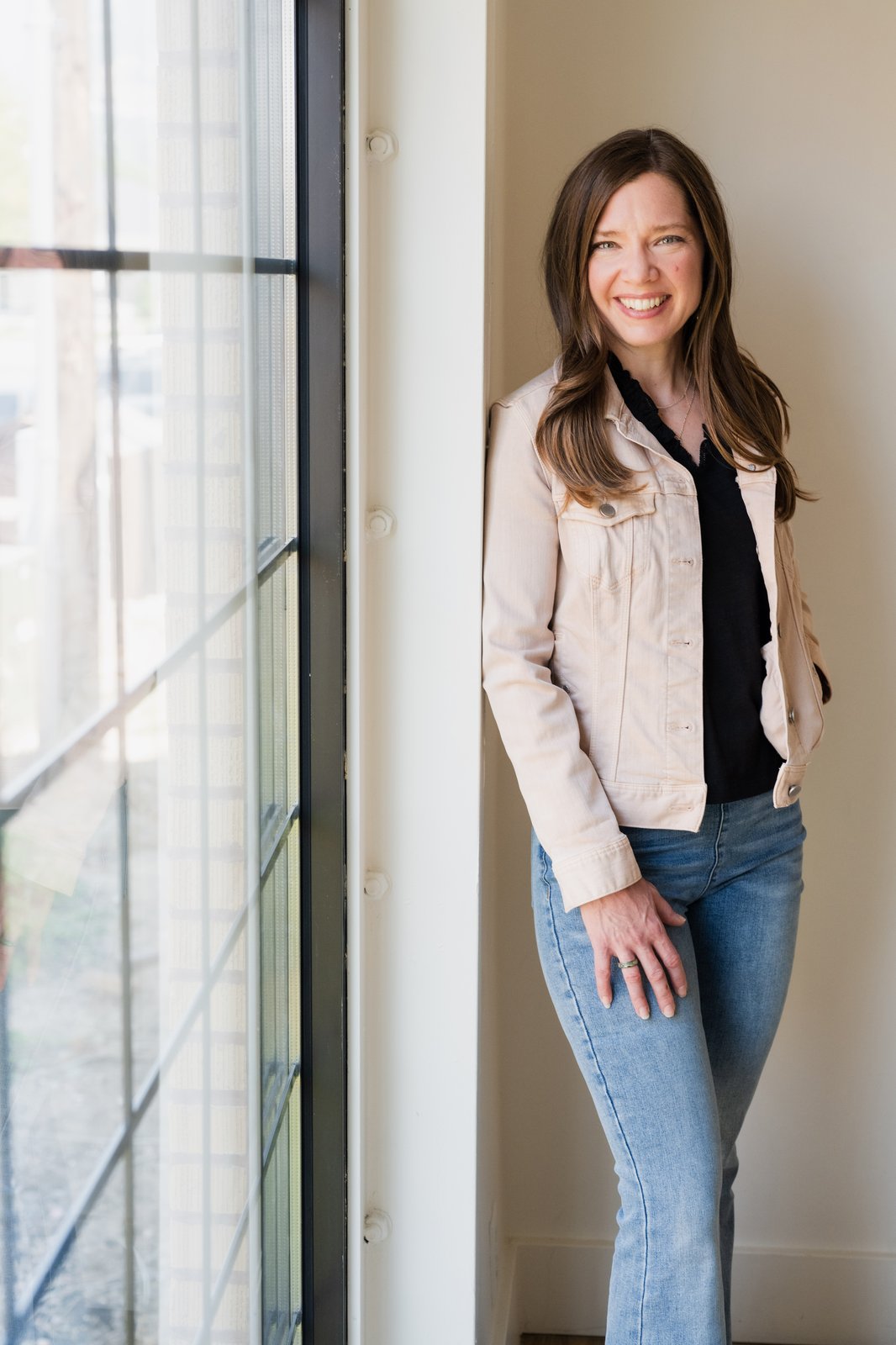
For most of my life, I knew exactly how to know I was doing okay: I achieved.
I earned the scholarships and the top grades. Early in my career as a dietitian, I was named Young Dietitian of the Year, served in leadership with the Utah Dietetic Association, and flew to Washington, D.C. to advocate for nutrition policy. Within two years of starting my career, I was in a leadership role.
Then came business school. An internship in New York. Feedback that I was the top intern in my class. A corporate leadership development program. A rotation in London. Bigger opportunities, more responsibility, another rung on the ladder.
I loved a lot of it. I was ambitious, curious, and capable.
And achievement had also become one of the primary ways I knew who I was.
As long as I was moving forward, accomplishing something, being recognized for what I could do, I didn't have to look too closely at the anxiety and self-doubt underneath it. My ambition was real. But tangled up with it was a belief I couldn't yet see: that my value was something I had to keep proving.
Then I became a mother.
And for the first time, succeeding by the rules I'd always followed no longer gave me a clear answer.
A new part of me wanted something that didn't fit neatly into the career path I'd spent years building. I wanted time with my children. I wanted balance. I didn't want every next step to require more hours, more visibility, more travel, more of myself.
I thought stepping back would simply be a career decision.
Instead, it became an identity crisis.
Because if I wasn't going to keep chasing the next impressive role, who was I?
Without realizing it, I began to lose my voice. I second-guessed myself in rooms where I once would have spoken freely. I pulled back. I watched other people advance and wondered what had happened to the version of me who had once been so certain she had something to offer.
On the outside, I was still capable.
On the inside, I was losing access to myself.
When the old answers stop working
Maybe your story looks nothing like mine.
Maybe you still want the bigger role — but you've lost confidence that you're capable of it.
Maybe you're good at what you do, but you're exhausted by the politics, frustrated with leadership, or tired of carrying more than anyone seems to notice.
Maybe you've achieved exactly what you set out to achieve and can't understand why it doesn't feel better than this.
Or maybe you're standing at a crossroads, wondering whether you need a new job, a new career, or simply a way to stop feeling this way.
Different circumstances. Similar questions:
- Why am I second-guessing myself when I know I'm capable?
- Why can't I turn work off, even when the workday is over?
- Why don't I feel like myself anymore?
- What do I actually want now?
- And can I trust myself to know?
Those questions became the beginning of a different kind of growth for me.
Not another achievement. Not another strategy for becoming better at managing myself.
I had spent years learning how to perform under pressure. I needed to learn how to stay connected to myself inside of it.
A different way of understanding what keeps us stuck
My path eventually led me to self-compassion, coaching, Internal Family Systems, and the study of attachment and human development.
And what I found changed the way I understood myself.
The parts of me I had spent years trying to overcome — the anxious part, the perfectionistic part, the part that second-guessed, the part that wanted everyone to be okay with my choices — weren't evidence that something was wrong with me.
They had learned ways of helping me succeed, belong, stay safe, and avoid disappointment.
Some of those strategies had worked extraordinarily well.
Until they didn't.
Trying harder wasn't the answer. Neither was getting rid of those parts of myself.
I needed to understand what they were trying to do for me, create enough space to hear what else was true, and learn to make decisions from something steadier than fear, pressure, or the need for approval.
Slowly, I began to trust myself again.
Not because I never felt anxious or uncertain. Not because I stopped caring what other people thought. And not because I gave up ambition.
I simply stopped requiring those things to disappear before I could hear my own voice.
That changed the way I worked, the way I made decisions, the way I showed up in relationships — and the way I understood leadership itself.
What fifteen years inside corporate talent taught me
At the same time, my corporate career gave me a front-row seat to another side of this question.
I spent fifteen years in HR, talent management, and leadership development, eventually working in enterprise talent planning and leadership potential assessment. I helped build and run the systems organizations use to identify talent, assess leadership potential, plan succession, and develop people for bigger roles.
My job was, quite literally, to think about human potential.
And over time, I became increasingly interested in the gap between the way potential looks on paper and the way it feels to the person living it.
I've seen extraordinarily capable people second-guess themselves. I've seen people become so good at adapting to what an organization needs that they lose touch with what they need. I've seen talented people go quiet after being overlooked enough times. I've seen success create opportunities — and I've seen the relentless pursuit of it slowly disconnect people from themselves.
And I've seen how easy it is, especially in the middle of a career, to mistake what you've learned to do to succeed for who you are.
That distinction sits at the heart of my work now.
The work I do today
Today, I coach mid-career professionals who feel stuck, disengaged, frustrated, or simply unlike themselves.
You may be successful by every external measure and still wonder why you're constantly second-guessing yourself. You may know you're capable but struggle to access that confidence when the stakes are high. You may be tired of managing everyone else's expectations, absorbing dysfunction around you, or carrying work long after you've closed the laptop. Or you may have reached a point where the career you've built no longer fits — and you don't yet know what does.
I'm not here to tell you whether to stay, leave, push harder, slow down, speak up, or reinvent your career.
I'm here to help you get clear enough to trust your own answer.
My coaching brings together my corporate experience, an MBA focused in organizational behavior, my background as a Registered Dietitian, ICF-accredited coach training, and advanced training in Internal Family Systems and attachment-informed approaches.
But the credentials aren't the point.
The point is that I understand both sides of the equation: the very real environments you're navigating on the outside and the patterns that can take over on the inside.
We work with both.
From managing yourself to leading yourself
Through my own experience and my work with clients, I developed SPACES — a six-step self-leadership practice for the moments when pressure is high and your familiar patterns start to take over.
It's not another system for controlling yourself better.
It's a way to create enough space between what happens and what you do next that you can hear yourself again.
Self-leadership isn't about always knowing the right answer. It's being able to stay connected to yourself when you don't.
It's noticing when fear, frustration, perfectionism, people-pleasing, or self-doubt has taken the wheel — and responding with curiosity instead of automatically obeying it. It's trusting your judgment without needing absolute certainty. It's being able to hear feedback without losing yourself in it. It's making decisions based not only on what you can produce, prove, or endure, but on what actually matters to you. And it's allowing your ambition to come from who you are — not from a need to prove that you're enough.
That's the work I wish I had understood years ago.
And it's the work I have the privilege of doing now.
You don't need someone else to hand you the answers to your life or career. You need enough space, self-trust, and clarity to hear your own.
That's where we begin.
Credentials & Training
- Registered Dietitian (RD)
- ICF-Accredited Coach (ACC)
- IFS-Trained Practitioner
- MBA, Organizational Behavior
- Jay Shetting Coaching School
- Pisgah Coaching Institute
- Center for Healing & Awakening
Foundations & Influences
- Intuitive Eating — Tribole & Resch
- Internal Family Systems — Richard Schwartz
- Interpersonal Neurobiology — Dan Siegel
- Self-Compassion — Kristin Neff
- Attachment Theory & Presence
- Somatic & trauma-informed practice